
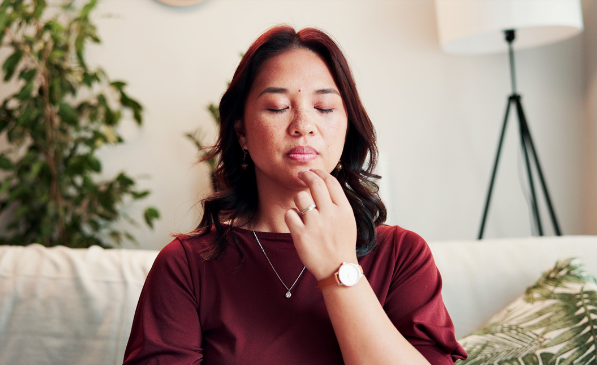
Everyone knows this feeling. Heart racing, chest tight, thoughts spinning faster than you can catch them. Your body has decided you're in danger, even if the "danger" is really just an overflowing inbox or a hard conversation you've been putting off. This is fight-or-flight, and once it takes hold, willpower alone rarely talks it back down.
This is where EFT comes in. Most people know it as tapping, but it's really a full method, combining tapping points, spoken phrases, and breathwork, all of which are covered in our Emotional Freedom Technique Practitioner Course. People describe feeling calmer almost as soon as they start. Increasingly, the explanation points to one very specific structure in the body: the vagus nerve.
What Is The Vagus Nerve, And What Does It Do?
The vagus nerve is the longest nerve in your autonomic nervous system, running from the base of your brain down through your neck, chest, and abdomen, touching your heart, lungs, and gut along the way. It's the main pathway of your parasympathetic nervous system, the "rest and digest" side that balances out the "fight or flight" stress response.
When anxiety takes over, your sympathetic nervous system is in the driver's seat. Heart rate climbs, breathing turns shallow, digestion pauses, muscles brace. A well-functioning vagus nerve is what pulls you back out of that state, slowing the heart, deepening the breath, and signalling to the brain that the threat has passed.
The vagus nerve is what calms your body down after stress. Practitioners often talk about "vagal tone," how well it does that job, and how easily you can shift from anxious back to relaxed. Slow breathing, humming, and cold water on the face are all great ways to help stimulate it.

What Tapping Is And Where It Fits In
Tapping is the physical technique at the centre of EFT: using your fingertips to gently tap on a series of points on the face and upper body, the eyebrow, under the eye, chin, and collarbone among them. EFT brings together a few elements at once, and it's likely the combination, not any single piece, that produces the calm:
Physical touch and pressure: Applied lightly and repeatedly to points on the face and upper body. Touch on its own has a calming effect on the nervous system, partly through vagal pathways.
Rhythmic, repeated movement: Anxiety often shows up as mental chaos, thoughts looping with nowhere to land. Rhythmic tapping gives the nervous system something steady to hold onto instead.
Naming the feeling out loud: EFT usually pairs tapping with a spoken phrase acknowledging what you're feeling, something like "even though I feel anxious right now." Putting a feeling into words has been shown to quiet the amygdala, the brain's threat-detection centre.
Slower, more intentional breathing: Most tapping routines naturally slow the breath, and a longer exhale is one of the most direct ways to stimulate the vagus nerve.
This last point is really mindfulness in a different outfit, using the breath as an anchor while thought is allowed to pass through. If that idea appeals to you on its own, it's the exact skill built from the ground up in our Mindfulness Practitioner Course.

What The Research Shows
There's a growing body of research behind tapping's calming effect. An Australian-led study using fMRI scans was the first in the world to capture tapping's calming effect on the brain visually, showing measurable changes before and after a session (Stapleton, Buchan & Mitchell, 2018). Australian researchers have also studied tapping in the classroom: a study across northern Australian primary schools found that student anxiety reduced across two stages of intervention (Lambert, Smith, Moss & Kirshbaum, 2022), and a separate study of Year 10 students found that using EFT as a universal intervention reduced academic fear of failure and anxiety over the course of the study (Stapleton et al., 2017).
This isn't a treatment or a diagnosis, and results vary from person to person. Still, the research points to a real, physiological effect, one likely driven by the combination of touch, breath, rhythm, and vagal stimulation working together.
Trying It For Yourself
You don't need to take a position on the theory to test whether this helps:
- Rate your anxiety from 0 to 10.
- Tap gently through the standard points: eyebrow, side of eye, under eye, under nose, chin, collarbone, underarm, naming what you're feeling as you go.
- Take a slow breath, letting the exhale run longer than the inhale.
- Rate your anxiety again.
If the number drops, that's useful information. If it doesn't move much, that's useful too. Tapping is one tool for an overactive nervous system, not a substitute for support when anxiety is ongoing.

Follow Along: A 5-Minute Tapping Routine
Prefer to be guided through it rather than reading off a list? Here's a short video tutorial so you can tap along in real time.
Where This Fits In A Holistic Picture
Tapping works best as one part of a wider stress-response toolkit, not a stand-alone fix. Alongside a regular mindfulness practice, it becomes easier to notice tension building before it tips into full fight-or-flight. If you'd like a guided, practical way to build that skill day by day, The Reset — 21 Days to Calm & Clarity is designed to do exactly that, calming the nervous system and building steadiness over three weeks of short, simple daily sessions.

Ready To Go Deeper?
If this article sparked something, our Emotional Freedom Technique Practitioner Course is the natural next step, taking you from the basics covered here into the full method: the technique, the theory, and how to apply it with others.
Mindfulness Practitioner Course: build the daily awareness practice that helps you catch anxiety early and stay anchored to the breath.
The Reset — 21 Days to Calm & Clarity: a guided, self-paced 21-day journey with two short sessions a day, built to calm the nervous system and bring a steadier sense of clarity and control.
All three, along with 40+ other courses, are included in the All-In Pass →
0 comments