
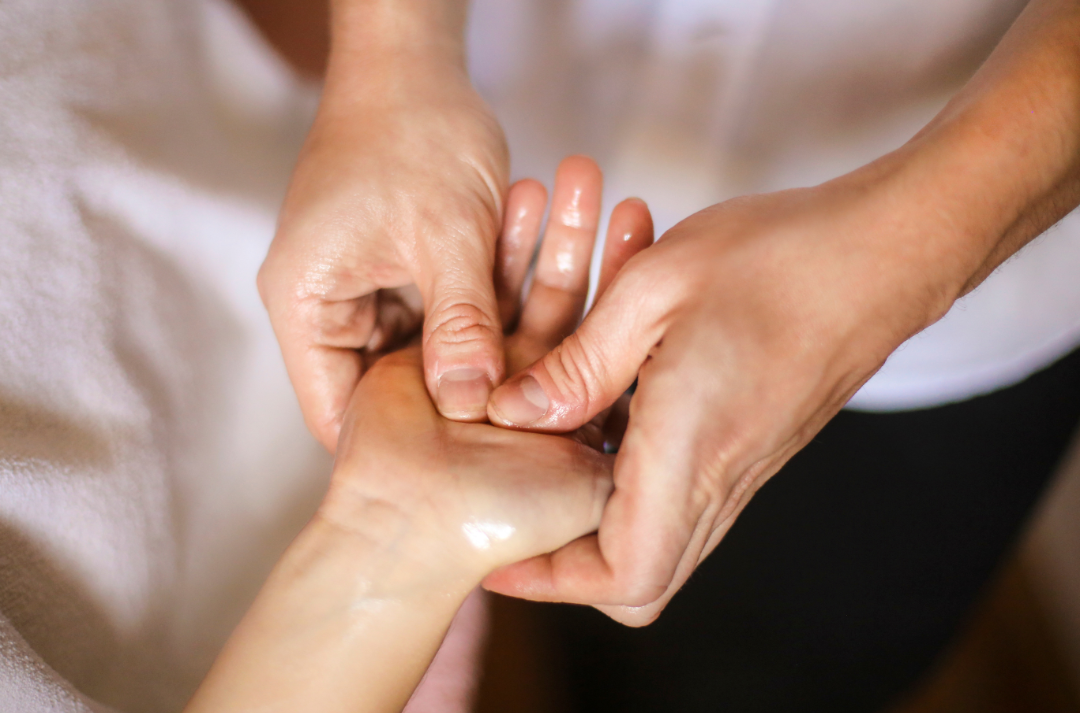
Keep reading to see a 5 minute acupressure desk routine
Pause for a moment and look down at your hands. If you've spent the day reading, taking notes, or typing through online course modules, they've likely done thousands of repetitive movements without you noticing. To a practitioner of acupressure, the hand is considered a map, traditionally believed to hold points connected to the rest of the body.
Acupressure has been used for centuries in Traditional Chinese Medicine (TCM), where gentle pressure is applied to specific points traditionally associated with relaxation, balance, and easing tension. This isn't a treatment or a diagnosis, but many find it a restorative way to pause and reconnect with the body during a long day of study or screen work.
Why Typing Can Leave Your Hands Feeling Tight
Typing may not look demanding, but repetition can contribute to stiff fingers, tight palms, aching wrists, and tension that travels into the neck and shoulders. Acupressure won't correct poor ergonomics or treat a medical condition, but many find it a grounding way to release tension that builds through the day.

How to Use Acupressure
You don't need to press hard for acupressure to feel effective. Apply firm, comfortable pressure to each point for 30 to 60 seconds while breathing slowly. Tenderness is common, but it should never feel sharp or painful.
Point 1 – LI4 (Hegu)
- Where is it? Locate the fleshy web between your thumb and index finger, slightly closer to the index finger bone.
- Traditional uses LI4 is one of the best-known points in acupressure, traditionally associated with head tension, neck stiffness, shoulder tightness, and general stress, making it a natural place to begin a routine.
- How to use it Press into the web of your hand with your opposite thumb and hold for 30–60 seconds. Repeat on the other hand.
Important: LI4 is traditionally avoided during pregnancy unless advised otherwise by a healthcare professional.

Point 2 – PC8 (Laogong)
- Where is it? Make a loose fist; the point lies roughly where your middle fingertip touches your palm.
- Traditional uses PC8 is traditionally associated with relaxation and releasing tension held in the palm, especially for hands tired from repetitive work.
- How to use it Massage the centre of your palm in slow circles with your thumb for around a minute.

Point 3 – PC6 (Neiguan)
- Where is it? Turn your palm upwards and measure roughly three finger-widths above the wrist crease, between two prominent tendons.
- Traditional uses PC6 is traditionally used for relaxation, wrist discomfort, and nausea, and is often included in routines for those spending hours at a keyboard and mouse.
- How to use it Apply gentle pressure with your thumb for a minute on each arm, slowly rotating your wrist as you hold the point.

Point 4 – SJ5 (Waiguan)
Where is it? Turn your arm over and measure about two finger-widths above the wrist crease, on the back of the forearm.
Traditional uses This point is commonly included in routines for shoulder tension, arm fatigue, and wrist mobility.
How to use it Hold steady pressure while gently bending your wrist forwards and backwards for a soothing effect after a long typing session.

Point 5 – HT7 (Shenmen)
- Where is it? Find the crease of your wrist on the little finger side, just beside the tendon.
- Traditional uses HT7 is traditionally associated with relaxation, emotional calm, and restful sleep, and many treat it as the natural final point in a routine.
- How to use it Apply light pressure for a minute while taking slow, even breaths.

Your 5-Minute Desk Routine
One: massage both palms. Two: hold LI4 on each hand. Three: press PC6 on both forearms. Four: stimulate SJ5 while rotating your wrists. Five: finish with HT7 and breathe slowly before returning to work.
We've put together a video tutorial so you can follow along step by step on TikTok.
Don't Forget to Stretch and Check Your Workspace
Your hands work hard all day, so give them a little back. Once an hour, open and close your fists, stretch your fingers wide, and roll your wrists slowly. While you're at it, try pressing or gently rubbing along your hand and forearm, the same kind of pressure used in acupressure. Many people like returning to the soft point between thumb and index finger (skip this one if you're pregnant). Roll your shoulders, then stand and walk for a minute. Glance at your setup too: elbows near 90 degrees, shoulders relaxed, wrists neutral, monitor at eye level, feet supported. Small, regular moments of care add up over a working day.

Where This Fits in a Holistic Picture
What does acupressure really offer you? It's an invitation to slow down and listen to your body. It won't diagnose a condition, and it's not a substitute for medical care. What it does offer is a moment of presence, a chance to notice where you're holding tension and where your energy, what practitioners call chi, might need rebalancing.
This looks different for everyone. Some experience it as part of a massage, worked in by a practitioner who knows the right points. Others carry a point home as a small self-care ritual between appointments, on a stressful commute, before a meeting, or at the end of a long day. Either way, the benefit is the same: instead of pushing discomfort aside, you get curious about it and respond with a little more care.

Ready to Go Deeper?
If this kind of mindful, hands-on practice speaks to you, our Acupressure Practitioner Course takes you from the points covered here through to full technique, theory, and professional practice.
And because acupressure works so well alongside meditation, natural therapy, and holistic counselling, it's a natural fit for the All-In Pass, giving you access to those courses and 40+ others at your own pace.
This blog is intended for general educational purposes and is not a substitute for professional medical advice. Always consult your GP or a qualified health professional about any concerns affecting your health.
0 comments